...

Five New Quiz Formats That Help Students Think More Deeply

Ellen Ovenden, MSc |

Many assessments still reward memorization more than real understanding. Students can pick the right answer without fully grasping a concept. In one study, trying to retrieve material from memory led to better one-week recall than repeated review: 60% versus 40%

Low-stakes interactive assessments help students actively remember information, reveal learning gaps early, and reduce the need to spend class time reteaching the basics.

Already used by more than 5,000 instructors globally, JoVE Quiz now includes five new question types that go beyond multiple choice, giving instructors more ways to check recall, reasoning, relationships, and application.

Hear how fellow faculty member Dr Blythe Janowiak from Saint Louis University uses embedded videos and quizzes to enhance lab safety and accuracy:  


How the New Question Types Support Your Teaching

The new question formats make JoVE quizzes more versatile without adding manual labor. All questions are auto-scored, with partial marking capturing what students do understand, even when an answer is incomplete.

Let’s look at how each format reveals student thinking differently, helping instructors match the question type to the skill or concept they want to assess.

1. True / False

Students decide whether a statement is correct. 

What it tests: Core understanding, factual accuracy, and common misconceptions. 

Example questions:

  • ▪️ True or false: Heat is released in an exothermic reaction.
  • ▪️ True or false: Electrons are lost during reduction.
True false

2. Dropdown

Students choose the correct term or phrase within a sentence or short passage.

What it tests: Understanding and application in context.

Example questions:

  • ▪️ During mitosis, chromosomes line up at the [metaphase plate / nucleus / cell membrane].
  • ▪️ The dependent variable is the factor that is [measured / changed / controlled].

Dropdown

3. Fill in the Blank

Students generate the answer themselves rather than selecting from options.

What it tests: Recall and precision without prompts, as well as understanding and application in context.

Example questions:

  • ▪️ In a microscope, the lens closest to the specimen is the ______ lens.
  • ▪️ The SI unit of force is the ______.

Fill in the blank

4. Match

Students pair related items from two lists.

What it tests: Understanding of relationships between concepts.

Example questions:

  • ▪️ Pair each scientific measurement concept with its correct definition.
  • ▪️ Match each piece of lab equipment to its correct use.

Match the Following

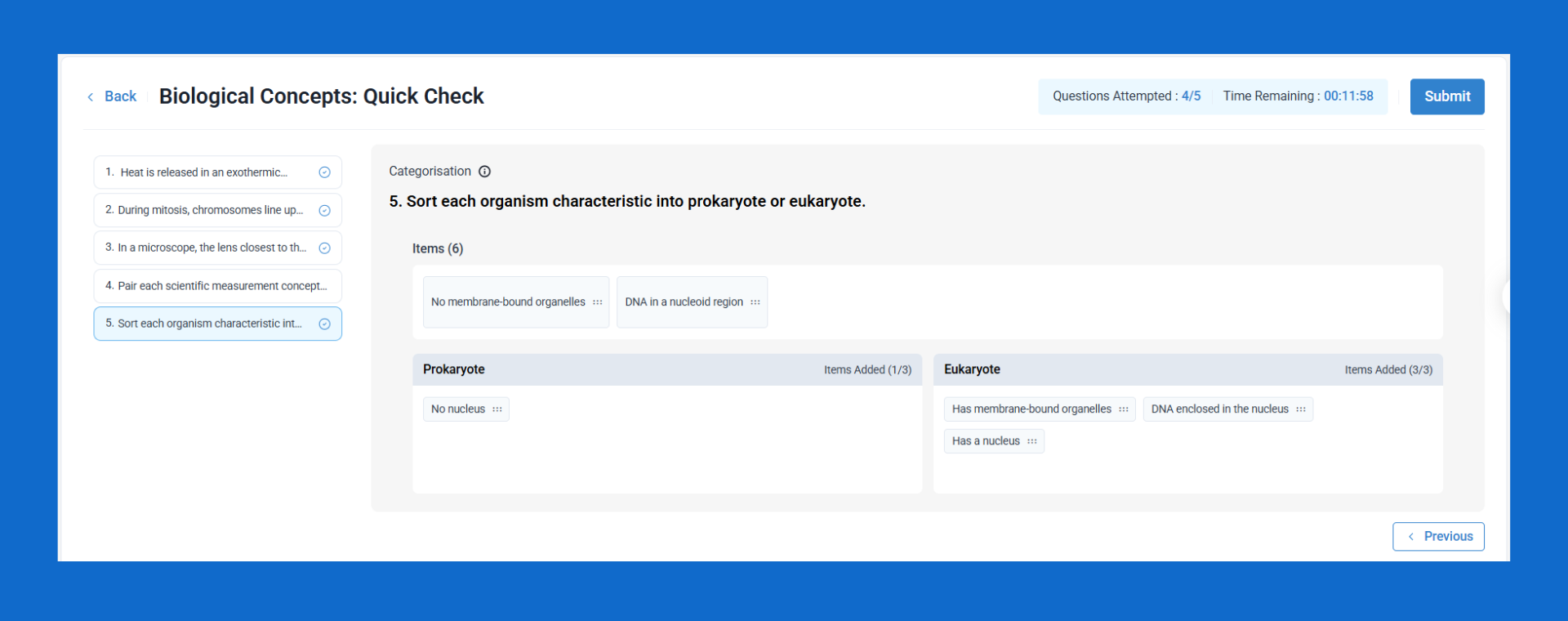
5. Categorization

Students sort items into the correct groups.

What it tests: Classification, comparison, and reasoning used to accurately distinguish between related concepts.

Example questions:

  • ▪️ Sort each organism characteristic into prokaryote or eukaryote.
  • ▪️ Sort each step into safe or unsafe lab practice.

Categorization


The Next Step

When assessment is built into learning rather than added at the end, students come to class better prepared, and learning gaps become clear. The new JoVE question formats make this easier to implement without increasing faculty workload. The result: more meaningful class time and better insights into how your students think.

 Explore JoVE Quiz for stronger preparation, better engagement, and less time spent on manual grading.

  1. Yao, Y., Amos, M., Snider, K., & Brown, T. (2024). The impact of formative assessment on K-12 learning: A meta-analysis. Educational Research and Evaluation, 29(7-8), 452-475. https://doi.org/10.1080/13803611.2024.2363831

Related Posts