

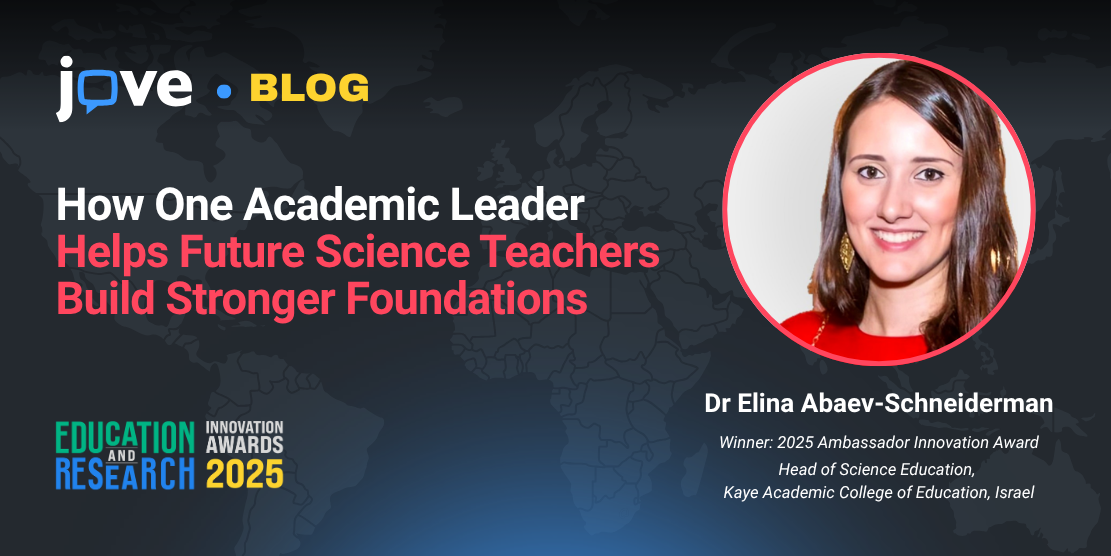


At Kaye Academic College of Education in Israel, every science lecturer now uses video resources.
When Dr Elina Abaev-Schneiderman, Head of Science Education, first proposed JoVE, some questioned why a teacher-education college needed something so academic.
The answer became clear in practice: Students engaged quickly. Colleagues adopted it too. Class preparation and discussion improved. This is what made Dr Abaev-Schneiderman stand out as the 2025 JoVE Ambassador Award winner.
A Model for Future Teachers
Dr Abaev-Schneiderman trains future science teachers, many of whom study in Hebrew as a second language. She drew on her experience in molecular biology, clinical lab work, and classroom teaching to make science learning clearer through visuals.
With support from JoVE’s team in Israel, Kaye became the first teacher-education college in the country to subscribe. In the first month of Kaye’s faculty using JoVE, student participation in JoVE-based assignments exceeded 85%, including 93% viewing for a microbiology video assignment.
Today, every science lecturer at Kaye uses JoVE videos, with built-in quizzes supporting reinforcement and checks for understanding.
Advice for Your Courses
1. Build visual learning into the routine.
- ▪️ Dr Abaev-Schneiderman did not treat JoVE as an occasional extra. Rather, she started embedding short videos into regular practice so that students met foundational concepts in a clear visual form before class.
2. Use quick quizzes as checks for learning gaps.
- ▪️ She uses JoVE quizzes as practice quizzes, not just assessment tools, giving students an immediate way to check themselves and instructors a quick view of how well the class is following.
3. Keep every resource tightly connected to the lesson.
- ▪️ Dr Abaev-Schneiderman stressed that the videos worked best when they were kept short, focused, and closely tied to the specific lesson. This made JoVE easier to fit into existing teaching without overloading students.
4. Use visual, multilingual support to reduce language load.
- ▪️ At Kaye, many students are Arabic-speaking and learning science in Hebrew. Visual explanation, subtitles, and structured presentations have helped shrink that barrier and make abstract concepts easier to follow.
5. Pay attention to what changes beyond the data.
- ▪️ One of the most insightful parts of Elina’s story is what surprised her about the experience: Engagement continued beyond formal requirements, and the level of questions and discussion in class was significantly raised. These are the kinds of shifts faculty should watch for, because they say more than a view count or test score alone.
Key Takeaway
Dr Abaev-Schneiderman’s work shows what can happen when future teachers learn science in the way they’ll need to teach it later: clearly, visually, and in a form their own students will be able to follow easily.
At Kaye College, this new direction went beyond one course or lecturer. It gave teachers in training a stronger model for science teaching, helped other faculty make the same shift to JoVE, and made visual science learning part of the college’s teaching culture.