The 2025 Nobel Prize in Chemistry put metal–organic frameworks, or MOFs, into the spotlight. These materials are known for their ability to capture and hold molecules like gases and water, thanks to their highly ordered internal structure.¹
As discussed in our earlier post on Nobel laureate Prof. Omar M. Yaghi, MOFs represent a broader shift in chemistry: researchers are no longer just discovering materials. They are designing them with a purpose.
But turning a powerful idea into something useful depends on more than design alone. It depends on how clearly methods are shared.
Why Seeing Methods Matters
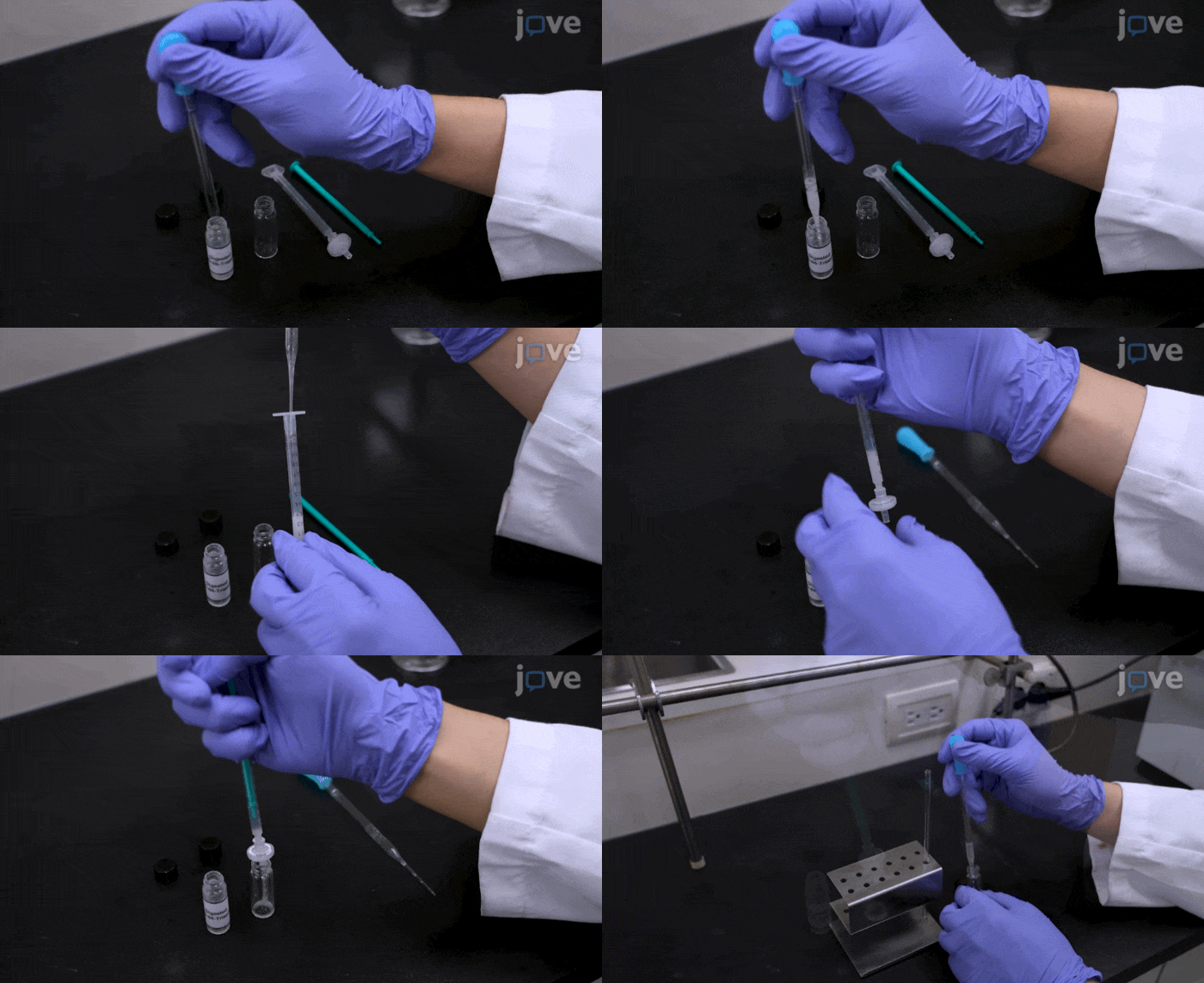
Many research workflows rely on details that are easy to miss on the page. Mixing speed, waiting time, visual cues, and material behavior during handling all influence outcomes. When these cues are unclear, results can vary between labs.
This is a well known problem. Studies on reproducibility show that missing procedural detail is one of the most common reasons experiments fail to replicate.¹ In materials research, including MOFs, this can slow progress and increase trial and error.
Seeing a method performed helps remove that uncertainty. Visualization shows what “normal” looks like at each step and how stages connect in practice.
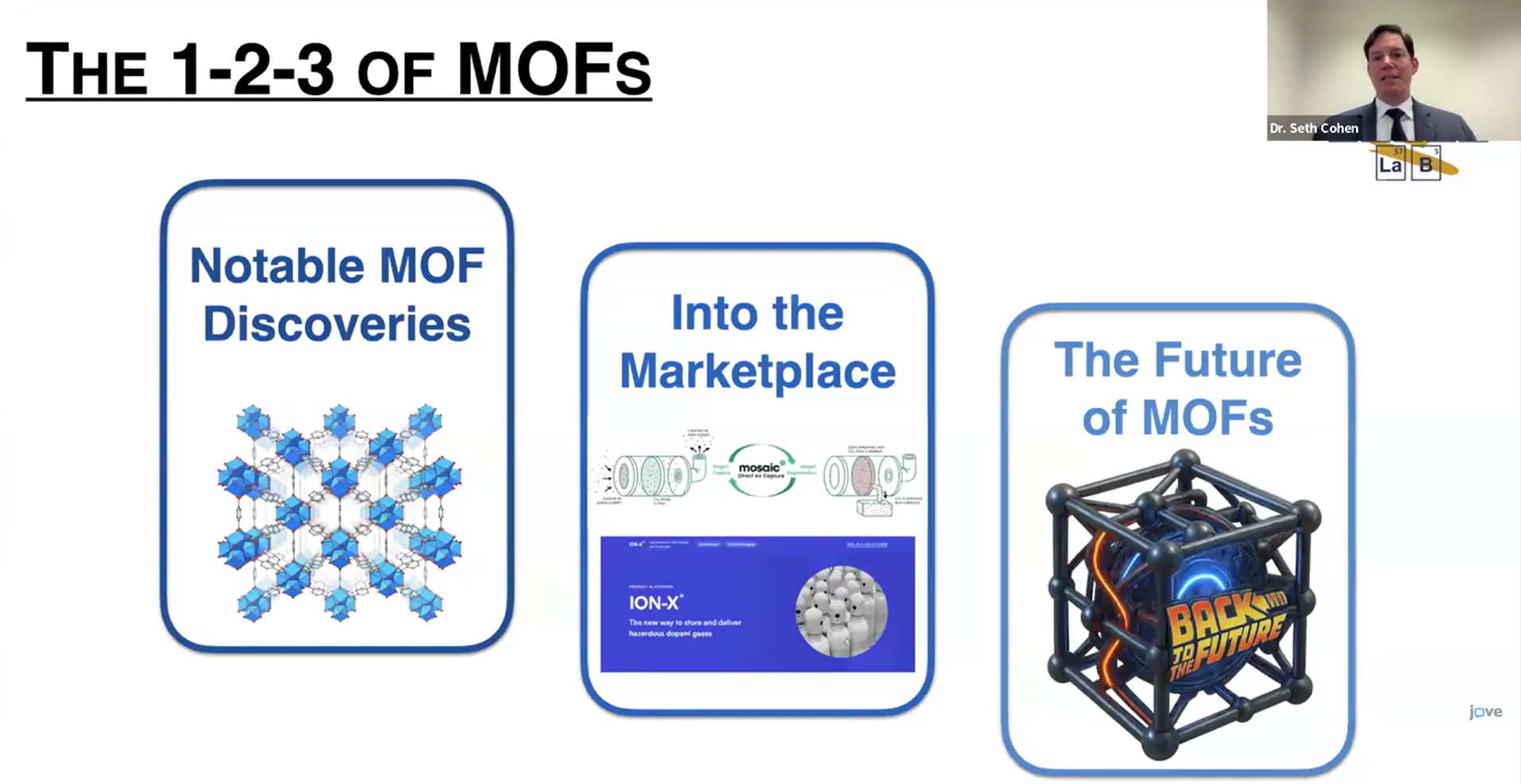
This point surfaced during the recent JoVE webinar Inside the Nobel-Winning Chemistry of Metal–Organic Frameworks (MOFs). While explaining why MOFs are so powerful, Dr. Seth Cohen (UC San Diego) noted, “The internal surface area of this material is spectacularly high.” That property depends on careful synthesis and handling. It only appears when the method is executed correctly.
Evidence from science education shows that visual demonstrations improve understanding of multistep procedures.² In research, reproducibility studies point to the same underlying issue: methods are often difficult to fully capture in text alone, especially for complex experimental work.¹
Beyond Interesting Materials
As MOF research has matured, attention has shifted toward practical questions:
- ⚙️ Will the material remain stable in real conditions?
- ⚙️ Can it be reused many times?
- ⚙️ Does it perform outside a controlled lab setting?
These questions matter because they shape how MOFs are tested and applied. In gas capture, researchers examine whether a material can repeatedly trap molecules like carbon dioxide or water vapor without losing performance. In chemical separations, success depends on whether pore structure remains consistent under operating conditions. In early-stage biomedical research, porous materials are explored for carrying or protecting sensitive compounds, where small changes in structure or handling can have large effects.
In all cases, progress depends on consistent methods, since small procedural differences can change performance. When details are easier to interpret, researchers can better assess results, identify sources of variation, and build on one another’s work.
This is especially relevant in collaborative fields like MOF research, where chemists, engineers, and materials scientists often work across institutions and disciplines.
Even when researchers follow the same protocol, outcomes can differ. Small differences in interpretation or execution can affect results, especially in complex workflows. Clearer descriptions of how methods are carried out help reduce confusion and make it easier to compare results across studies.
A Broader Takeaway
One of the most valuable aspects of the webinar was its focus on MOFs across the full research life cycle. The conversation moved from fundamental design to questions of stability, reuse, and real-world constraints. Rather than focusing on a single breakthrough, it showed how progress in the field has depended on years of method refinement and shared problem solving across many laboratories.
That perspective applies far beyond MOF chemistry. As research becomes more complex and more collaborative, outcomes increasingly depend on how methods are interpreted, tested, and compared. Advances emerge not only from new materials or ideas, but from a clearer understanding of how experimental choices shape results.
The Nobel Prize recognized the design of MOFs. The discussion around it highlighted something broader: scientific progress relies on methods that others can understand, evaluate, and build upon over time.
Learn more about publishing visual methods with JoVE to support reproducibility and transparency.
- Baker, M. (2016). 1,500 scientists lift the lid on reproducibility. Nature, 533(7604), 452–454. https://doi.org/10.1038/533452a
- Brame, C. J. (2016). Effective educational videos. CBE—Life Sciences Education, 15(4), es6. https://doi.org/10.1187/cbe.16-03-0125