...

Reducing Deviation Risk in Pharma Labs with Visual Training

Ellen Ovenden, MSc & Rucha Joshi, MSc |

Deviations are expensive. In pharma and biotech R&D, each incident can trigger a full deviation investigation, including root-cause analysis, documentation, approvals, and often repeat work on time-sensitive assays. Even when issues are minor, the investigation burden and deviation documentation burden add up across a portfolio.

Many so-called “lab deviations” are not just paperwork problems. They often arise from small differences in how a method is executed, such as pipetting angles, mixing order, incubation timing, or how staff interpret an SOP during a busy shift. In other words, technique variability in labs is a recurring source of risk. Prevention is more scalable than chasing every event through CAPA (Corrective and Preventive Actions).

This post looks at how visual, standardized method training can support deviation management in R&D labs: not by replacing SOPs, but by making execution clearer, more consistent, and easier to refresh across teams and sites.


What Counts as a Deviation in Pharma & Biopharma Labs?

In Good Manufacturing Practice (GMP) environments, GMP deviations are any unplanned departure from an approved instruction, procedure, specification, or standard.¹ These can occur in development labs as well as manufacturing when methods are run under quality systems.

Common categories include:

  • 💠
    Procedural deviations: A required step is missed, performed out of sequence, or performed by someone without documented training.
  • 💠 Documentation deviations: Missing, late, or incorrect entries in batch records, lab notebooks, or electronic systems.
  • 💠 Equipment deviations: Use of uncalibrated instruments, out-of-tolerance readings, or incorrect settings.
  • 💠 Method-execution deviations: Technique differences that change assay conditions (mixing order, incubation time, vortex intensity, plate layout).


In practice, many GMP deviations cut across categories. For example, a sample incubated for longer than specified may involve both a technique issue and incomplete documentation. From a deviation management perspective, you still need to understand exactly what went wrong and how to prevent it from happening again.


Why Deviation Investigations Get Expensive (Fast)

Each investigation consumes time from QA, line managers, and scientific subject-matter experts. Over a year, that has a real impact on throughput and timelines.

Direct costs include:

  • 💵
    Hours spent on deviation investigation and root cause analysis
  • 💵 Reviewing investigation reports and CAPAs.
  • 💵 Repeated testing when impact cannot be ruled out.


Indirect costs include:

  • 💵
    Downtime on equipment or methods during investigations
  • 💵 Project delays and workflow bottlenecks
  • 💵 Resources diverted from development and method transfer work
  • 💵 Recurring deviations that drain capacity and raise questions during audits²


Our earlier piece on reducing assay variability and reproducibility in pharma labs explored how GxP variability translates into risk and rework. Across quality systems, repeat deviations are a signal that the CAPA system is not addressing the true root cause.2 When issues are driven by inconsistent technique, better laboratory training best practices are often more effective than more forms or stricter sign-off.


Why Text SOPs Alone Fall Short

SOPs are essential, but on their own, they have limits for preventing procedural deviations:

  • 📋
    They document “what,” but not always “how.”
  • 📋 Many critical technique details (speed of pipetting, angle of insertion, visual cues) are tacit, not written.
  • 📋 Staff interpret the same text differently across operators, shifts, and sites.
  • 📋 Over time, small local adaptations accumulate, leading to method drift and making standardizing lab techniques harder.


Even well-written SOPs can have limited effectiveness if training stops at “read and sign.” Studies of lab error show that unclear procedures and insufficient training are major contributors to preventable mistakes, and that clearer guidance and practice reduce error rates and improve patient and product safety.3

For a deeper dive into risk reduction in regulated biotech environments, join our upcoming webinar on February 19 focused on practical strategies to reduce risk through training, standardization, and reproducibility. 

bde78659-366b-4149-a18a-aee4b7b24a17

A Preventive Framework for Reducing Deviation Risk Upstream

A preventive approach focuses on reducing deviations before they reach the CAPA queue. Four elements are particularly useful in R&D and early development labs:

✅ 1. Standardize method execution, not just the SOP

Define critical technique steps, acceptable ranges, and where discretion is allowed to reduce ambiguity at the bench.

✅ 2. Build standardized method knowledge
Create a single, visual “source of truth” for how each critical method should be performed, supporting training consistency across teams and sites.

✅ 3. Train for reproducibility, not just compliance
Pair SOPs with practice, demonstration, and feedback, especially for complex or high-risk methods.

✅ 4. Use trends to target refreshers

Use deviation trends to deploy focused training where execution-related issues recur.


Why Visual Training Helps Reduce Deviation Risk

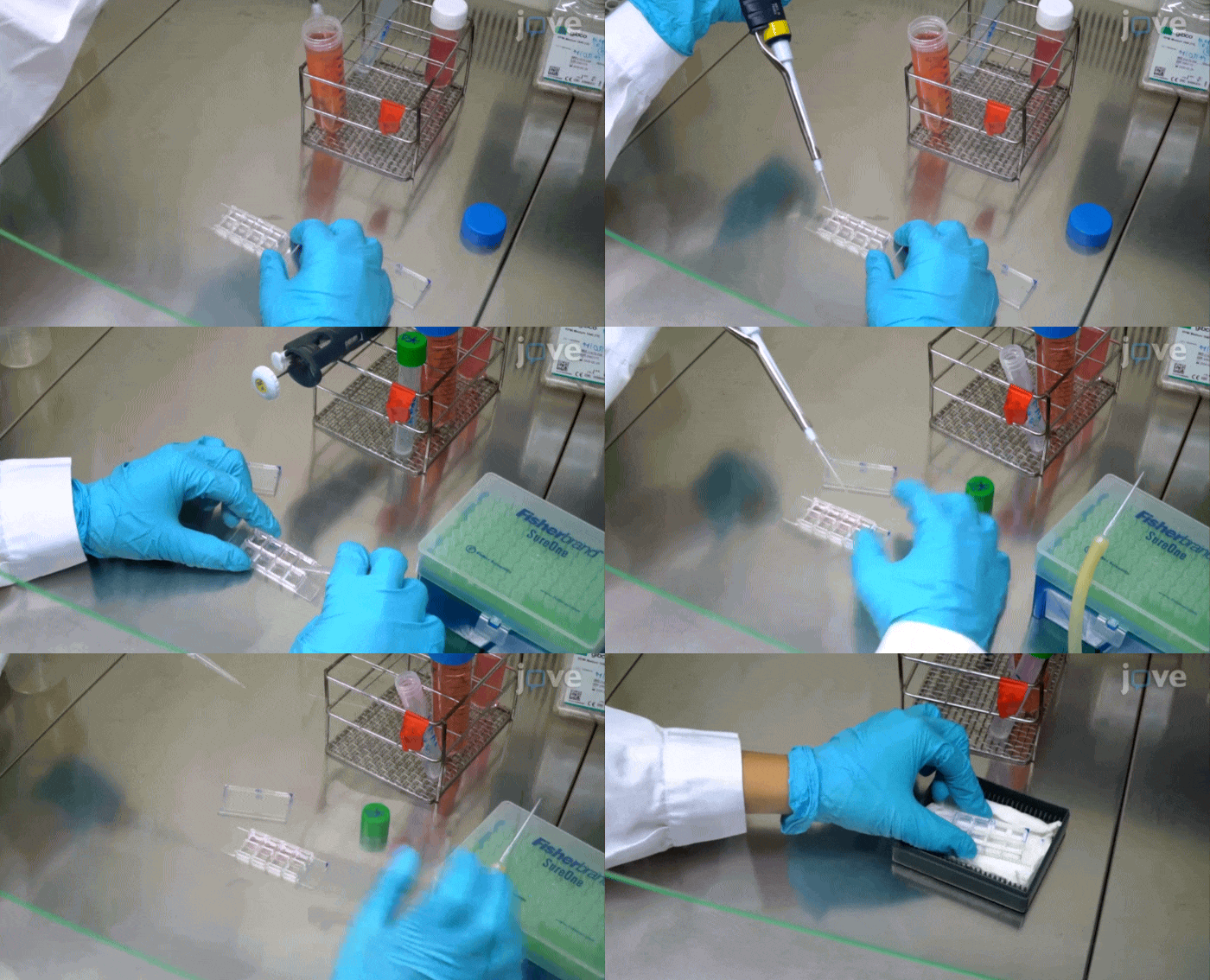
Visual resources, such as high-quality video protocols, make techniques visible in a way text cannot and strongly support visual training for pharma by:

  • 🔸
    Showing timing, hand movements, and critical checkpoint
  • 🔸 Clarifying sequencing and setup for complex workflows
  • 🔸 Giving staff a way to revisit methods before infrequent or high-risk procedures


Research in education and laboratory teaching shows that video-based instruction improves skill acquisition and retention compared with text-only approaches, especially for procedural tasks.4,5 When staff can see what “right” looks like, it is easier to reduce technique variability, human error, and assay variability across operators.

Visual resources are also easier to integrate into everyday work. Embedded into LMS and LIMS systems, video-based lab training can be assigned alongside SOPs, used during onboarding, and revisited whenever methods change. Over time, this supports more robust knowledge transfer in pharma and reduces reliance on a small number of senior experts.

  • MethodsCollection (1)
  • Biopharma 1-1

How JoVE Supports Visual Training & Knowledge Transfer

JoVE’s video resources are designed to complement written SOPs and internal training. They support standardized method knowledge and consistent execution by:

  • 📽️
    Providing step-by-step demonstrations of core and advanced lab techniques
  • 📽️ Supporting SOP training effectiveness by pairing written instructions with visual execution
  • 📽️ Helping teams improve training consistency across sites through shared, expert-led content
  • 📽️ Making it easier to refresh skills quickly during deviation management and method updates


For readers who want to connect visual training with measurable impact, our earlier article on video-centered training for biopharma teams explores how video-enabled training relates to time to independent work, deviation trends, and rework.


Shifting Deviation Management Upstream

Investigations and CAPAs will always be part of regulated work. However, the most effective way to reduce deviations over time is to treat training and standardized method knowledge as core quality controls, rather than just support activities.

By combining clear SOPs, visual method demonstrations, and targeted refreshers, pharma and biotech labs can reduce technique-driven events, lower the investigation burden, and strengthen deviation management without adding more layers of paperwork.

For labs looking to strengthen deviation management in 2026, JoVE’s visual resources can support training, method transfer, and reproducibility.

Explore JoVE as a training and knowledge transfer resource to help prevent GMP deviations before they start.

  1. Scilife. (2024). How to handle deviations in pharma effectively. Scilife Blog. https://www.scilife.io/blog/how-to-handle-deviations 
  2. CfPIE. (2025). Turning mistakes into improvements: GMP deviations and effective CAPA systems. CfPIE Insights. https://www.cfpie.com/turning-mistakes-into-improvements-gmp-deviations-and-effective-capa-systems 
  3. Lam, J. C., & Church, D. L. (2024). Preventing laboratory error and improving patient safety. Clinical Infection in Practice, 22, 100345. https://doi.org/10.1016/j.clinpr.2024.100345 
  4. Maldarelli, G. A., Hartmann, E. M., Cummings, P. J., Horner, R. D., Obom, K. M., Shingles, R., & Pearlman, R. S. (2009). Virtual lab demonstrations improve students’ mastery of basic biology laboratory techniques. Journal of Microbiology & Biology Education, 10(1), 51–57. https://pmc.ncbi.nlm.nih.gov/articles/PMC6373476/ 
  5. García-Ros, R., & Alhama, P. (2023). Online laboratory practices and assessment in the hybrid environment: Students’ perceptions and learning outcomes. Heliyon, 9(7), e19742. https://doi.org/10.1016/j.heliyon.2023.e19742 

Related Posts